How To Structure An Investor Presentation

A beautifully designed investor presentation won’t achieve much if the story isn’t clear.

I’ve seen presentations packed with data, charts and financial projections that still leave audiences wondering what the investment opportunity actually is. The challenge isn’t usually a lack of information. It’s how that information is organised.

Investors are often reviewing dozens of opportunities, presentations and reports. They need to understand the story quickly and confidently. Good investor presentations don’t just present information. They guide audiences through a logical narrative that builds understanding and trust.

Start With The Investment Case

Before discussing products, technology or future plans, investors need to understand why they should care.

The opening section should answer a simple question:

Why is this business worth paying attention to?

This might include:

  • Market opportunity
  • Competitive advantage
  • Growth potential
  • Proven track record
  • Unique proposition

Think of this as the executive summary of the presentation. It sets the direction for everything that follows.

Audience watching a panel discussion on a bright green conference stage with large presentation screens.

The best investor presentations don’t simply share information. They guide audiences through a story that builds understanding, confidence and trust.

Explain The Business Clearly

One of the most common mistakes in investor presentations is assuming the audience already understands the business.

Even if investors know the company, it’s important to establish a clear understanding of:

  • What the company does
  • Who its customers are
  • How it generates revenue
  • What makes it different

Complexity creates friction. Simplicity creates confidence. The goal isn’t to impress people with industry jargon. It’s to help them understand the business model as quickly as possible.

Demonstrate Market Opportunity

Investors want to know how large the opportunity is and whether the business can realistically capture it.

This section typically covers:

  • Market size
  • Industry trends
  • Customer demand
  • Emerging opportunities
  • Future growth areas

Strong visualisation is particularly important here. Large numbers and market data are far easier to understand when transformed into clear, meaningful graphics.

Show Evidence Of Performance

Once the opportunity has been established, investors need proof that the business can deliver.

This is where data becomes critical. Performance indicators might include:

  • Revenue growth
  • Customer acquisition
  • Retention rates
  • Market share
  • Product adoption
  • Operational performance

The best investor presentations don’t overwhelm audiences with spreadsheets. They focus attention on the metrics that matter most.

Explain The Strategy

Investors are not only investing in where the company is today. They’re investing in where it’s going next.

A strong strategy section should outline:

  • Future priorities
  • Growth initiatives
  • Product development
  • Market expansion
  • Technology investment

Most importantly, it should explain how these initiatives contribute to long-term value creation.

Introduce The Leadership Team

People invest in people.

A brief section introducing the leadership team helps build credibility and confidence. Focus on relevant experience, industry expertise and proven delivery rather than lengthy biographies. Investors want reassurance that the people leading the business can execute the strategy being presented.

End With A Clear Summary

A surprising number of presentations simply stop.

Strong investor presentations finish by reinforcing the key messages that matter most. This final section should remind audiences:

  • Why the opportunity exists
  • Why the company is well positioned
  • Why now is the right time
  • What success could look like

If investors can clearly repeat your investment story after the presentation, you’ve done your job.

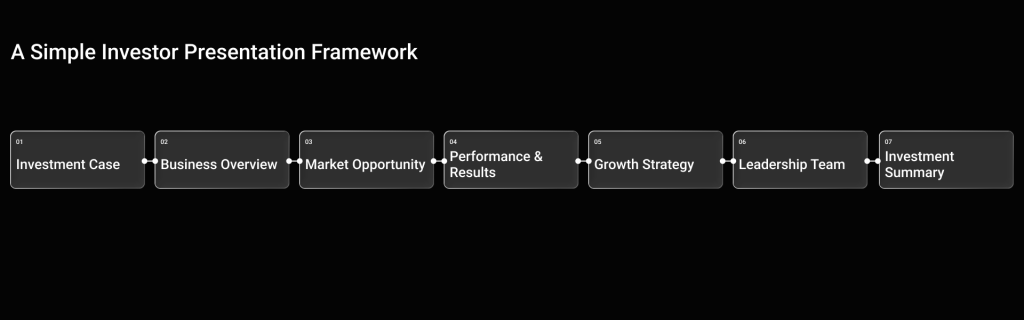
A Simple Investor Presentation Framework

Many successful investor presentations follow a structure similar to this:

Investor Presentation Design Framework for Business Growth and Investment Communication

The exact content will vary, but the principle remains the same. Lead audiences through a story rather than presenting disconnected information.

Final Thoughts

Investor presentations are often viewed as financial documents.

In reality, they’re communication tools. The most successful presentations combine strategy, storytelling and design to help audiences understand a business quickly and confidently. When information is structured effectively, investors spend less time trying to work out what you’re saying and more time focusing on the opportunity itself.

And that’s where great presentation design begins.

I’m Nick Farrow, a Senior Graphic Designer based in Brighton with over 30 years’ experience creating design for live experiences, presentations, digital platforms and brand communications. My work focuses on helping organisations turn complex ideas into clear, engaging visual systems that connect with their audience.

Find out more about my background and approach.

Make Your Investor Presentation Clearer

Need help turning strategy, data and business detail into a presentation investors can follow with confidence?